Products List

Rückstandslose Löschmittel / Löschsysteme

  • General Overview

    overview

    Clean Agent Systems

    Clean fire extinguishing agents include halon, halon replacements and inert gases. These gases are used in total flooding extinguishing systems to avoid lethal conditions for occupants given that the proper design and installation of such systems. The primary distinction between carbon dioxide and clean agents is the toxicity of the gas. Carbon dioxide extinguishing concentrations exceed its fatal limits while clean agents extinguishing concentrations are below their toxic thresholds. Halons have been identified as stratospheric ozone-depleting substances. As consequence of application of Montreal Protocol on Substances that Deplete Stratospheric Ozone, production of halons was ceased in developed countries by 1994. It’s currently being phased out in the last developing country that produces halons. Despite these facts, many halons systems remain in use worldwide. Recycled halons serve as source of supply for mobile military equipment, aviation application and explosion prevention application that remain dependent on halons. Currently, the transition to other forms of halon replacements is well underway. NFPA12A, Standard for Halon 1301 Fire Extinguishing Systems and NFPA2001, Standard on Clean Agent Fire Extinguishing Systems are published by the National Fire Protection Association (NFPA) to address halon, halon replacements and inert gases application in fixed systems. Clean fire suppression agents are defined as fire extinguishants that vaporize readily and leave no residue. Clean agent halon replacements fall into two categories:

    1. Compounds
    2. Inert Gases and Mixtures (e.g. nitrogen and argon, and blends of these)
    Halocarbon clean agents share several common attributes as follows:
    1. All are electrically nonconductive
    2. All vaporize readily and leaves no residue
    3. All are liquefied gases or display analogous behavior
    4. All can be stored and discharged from typical Halon 1301 hardware
    5. All use nitrogen super pressurization in most application for discharge purposes
    6. All are total flooding gases after discharge
    7. All are less efficient fire extinguishants than Halon 1301 with respect to storage volume and agent weight i.e. they require increased storage capacity.
    8. For  the same fire type, size and discharge time, they all produce more decomposition products than Halon 1301.
    Inert gas clean agents are stored as pressurized gases and hence require substantially greater storage volume. They are electrically nonconductive, form stable mixtures in air and leave no residue.Clean agents extinguish fires by a combination of chemical and physical mechanisms, depending on the compound. Halons suppress fires chemically by scavenging flame radicals, thereby interrupting the chemical chain reaction. Other halocarbon compounds suppress fires primarily by extracting heat from the flame reaction zone, reducing the flame temperature below that which is necessary to maintain sufficiently high reaction rates by a combination of heat vaporization, heat capacity and the energy absorbed by the decomposition of the clean agent. Inert gas agents suppress flame by reducing the flame temperature below the threshold necessary to maintain combustion reactions. This is done by reducing the oxygen concentration and by raising the heat capacity of the atmosphere supporting the flame.

    The minimum extinguishing concentrations of total flooding systems for class A fires are determined as part of third-party approval process. Class B fires extinguishing concentrations are determined by the cup burner method. Total flooding systems are also used for explosion inerting. The inerting concentration is that required to prevent an acceptable pressure increase in a premixed fuel / air / agent mixture subjected to ignition source. Such systems employ rapid delivery of agent following very early detection of an ignition.  These systems must be specifically designed for each application as there are no generic design requirements or standards available.

    One of the main concerns when it comes to the use of clean agents in fire protection is the agent toxicity. Toxicology tests are performed based on:

    1. The duration and frequency of exposure
    2. Determination of specific biological effects
    The No Observed Adverse Effect Level (NOAEL) and the Lowest Observed Adverse Effect Level (LOAEL) for each agent are obtained among these tests. The NOAEL is the highest concentration of an agent at which no adverse effect occurred while the LOAEL is the lowest concentration of an agent at which an adverse effect was measured. The use of halocarbon clean agents in occupied area is generally subjected to the constraint that the design concentration must be less than NOAEL. On the contrary, inert gases are physiologically inert. Their primarily physiological problem is the reduced oxygen concentration caused by the high agent design concentration. Inert gases can be used in concentrations up to 43% in normally occupied areas (a residual
    oxygen concentration of 12%).There are two main environmental impacts need to be considered with halocarbon clean agents

    1. Ozone depletion
    2. Global Warming
    The ODP (Ozone depletion Potential) is used to address ozone depletion impacts of a halocarbon agent. It is a measure for the relative amount of ozone destroyed as compared with an arbitrary standard. The atmospheric life time is used also to address environmental impacts not on base of an identified harmful effects but on the base of the current uncertainty if there are harmful effects or not. The GWP (Global Warming Potential) is used to address global warming. The GWP is the cumulative amount of radiative forcing between the present and some future time caused by a unit mass (weight) of a compound, as compared with the same unit mass (weight) of an arbitrary standard. The radiative forcing is defined as anything that will cause the energy balance at the top of the troposphere to no longer be in balance. All chemicals with a non-zero ODP is subjected to phase out under Montreal Protocol. HFCs and PFCs are part of the basket of industrial gases included in Kyoto Protocol and may be subjected to emission controls in signatory nations, however they present less than 1% of greenhouse gas emission on a carbon equivalency basis which are used as fire extinguishants.
    Clean agent systems methods of application are:
    1. Total Flooding Systems
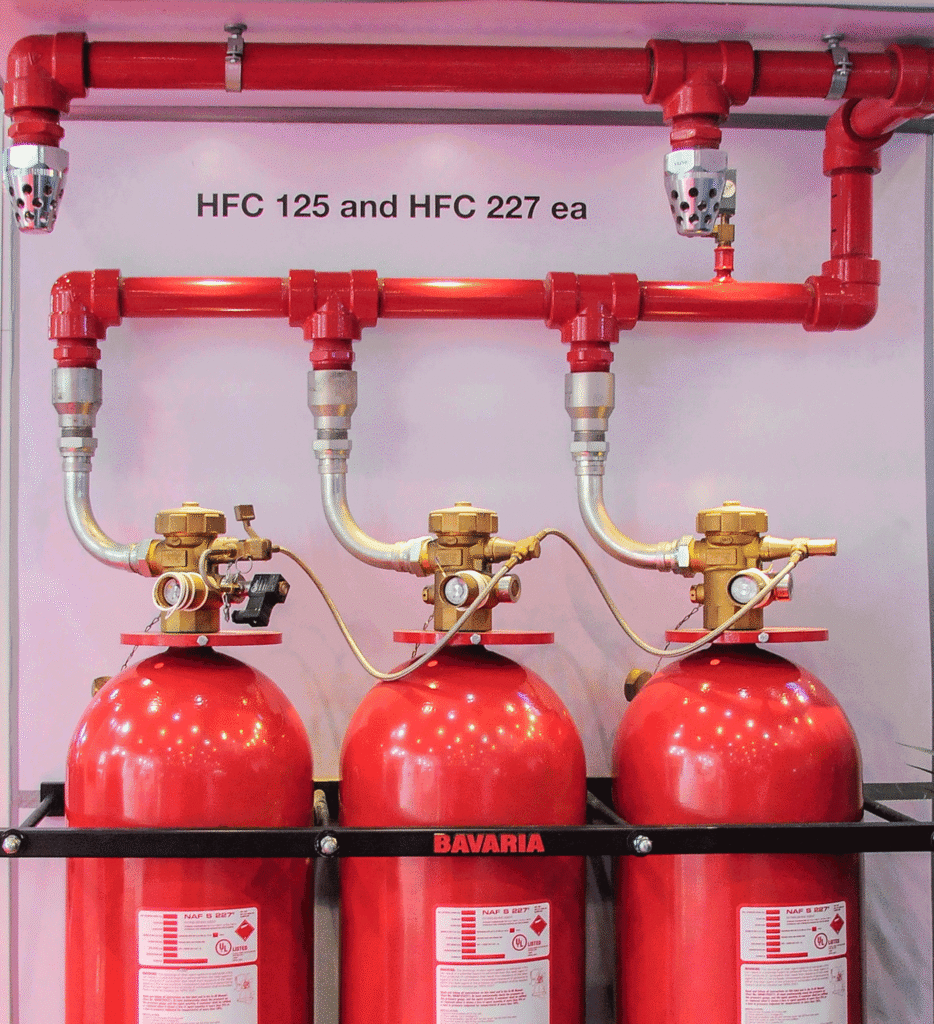
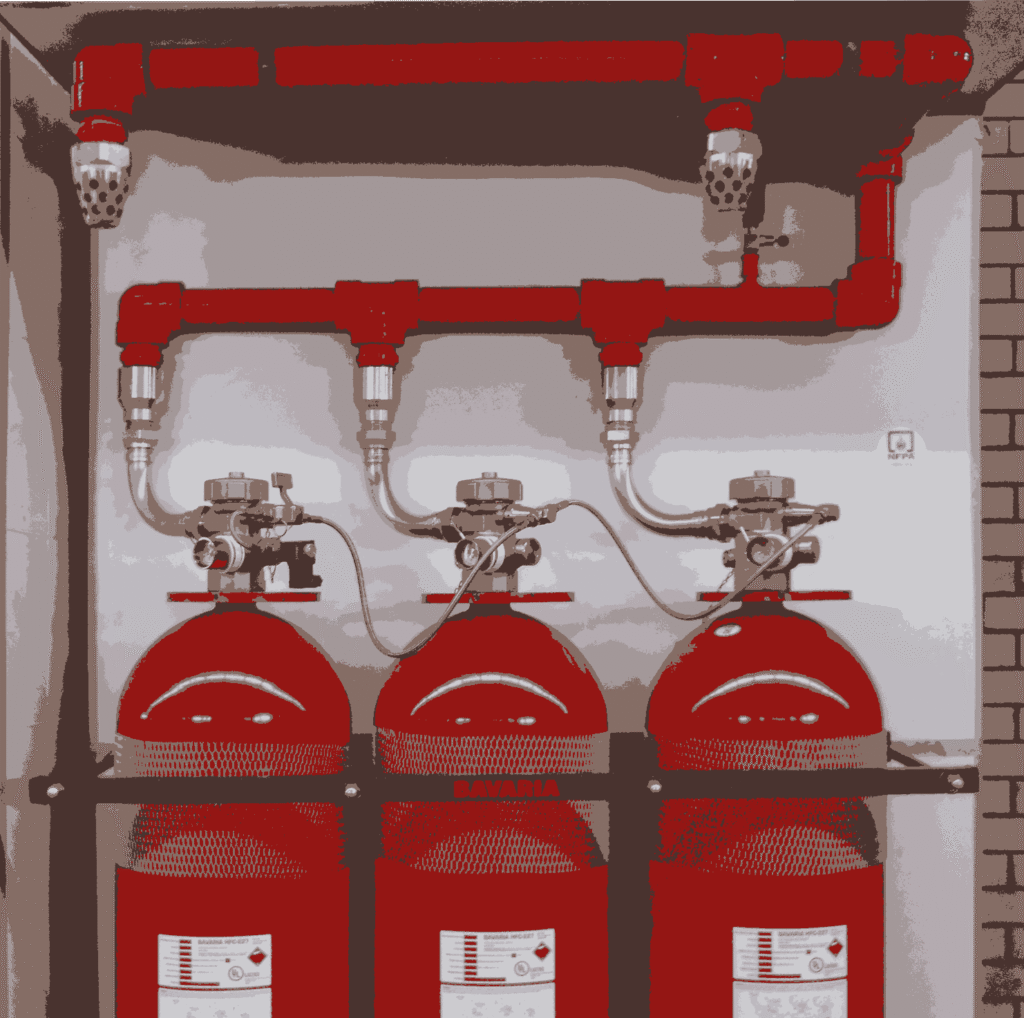
      These systems protect enclosed or at least partially enclosed hazards. They are either engineered systems or pre-engineered systems. Engineered systems are custom designed for each hazard using components approved for their broad performance characteristics. Such components may be arranged in almost unlimited variety of configurations. On the contrary, the number of components and configurations of a pre-engineered system  is determined in advance and included in the description of the system approval. Total flooding systems are categorized into modular systems and central storage systems. The modular systems consist of single containers connected to discharge nozzles. These systems are often of less initial cost and high maintenance cost. Central storage systems locate all agent containers in one centralized location and use piping network to distribute the agent to discharge nozzles in various locations.
    Total flooding clean agents’ advantages are:
    1. The ability to extinguish shielded, obstructed, or three-dimensional fires in complex geometries
    2. The ability, using appropriate detector-based actuation, to extinguish fires at a very early stage, well before direct or indirect fire/smoke damage occurs
    3. The ability to cause no collateral damage due to agent discharge.
    1. Local Application Systems
    These systems discharge extinguishing agent in such a manner that the burning object is surrounded locally by a high concentration of agent to extinguish the fire.
    All previously discussed systems and components are provided by Bavaria to satisfy the customers‘ needs. Please check our products technical datasheets for more information or contact us.

    Learn More
  • BAVARIA® HFC-227 Engineered Systems

    Features

    BAVARIA HFC-227 Engineered Systems

    1. Available in both low pressure system { 25 bar (360 psi) } and high pressure system { 42 bar (610 psi)} for greatest system design flexibility
    2. Wide selection of cylinder sizes from 5 – 240 L (12 -590 lb)
    3. High pressure systems easily accommodate remote cylinder installation, freeing up valuable space inside the protected enclosure
    4. Wide operating temperature range 0°C (32°F) up to 50°C (122°F)
    5. UL listed and designed in accordance to NFPA 2001, Standard on Clean Agent Fire Extinguishing Systems

    BAVARIA HFC-227 Extinguishing Agent

    1. Patented formula which is proven to reduce products of combustion and decomposition
    2. Patented formula which is proven to improve fire extinguishing performance, leading to improved safety factors
    3. Suitable for use in Class A, Class B and Class C fires
    4. UL component recognized agent
    5. Nonconductive, non-corrosive, requiring no post discharge clean up
    6. Zero ozone depletion potential and low (negligible) global warming potential

    Learn More
  • GESAMTÜBERSICHT

    Überblick

    Clean Agent-Systeme
    Rückstandslose Feuerlöschmittel umfassen Halon, Halonersatz und Inertgase. Diese Gase werden in Löschsystemen mit vollständiger Flutung verwendet, um tödliche Zustände für die Insassen zu vermeiden, vorausgesetzt, dass solche Systeme ordnungsgemäß konstruiert und installiert werden. Der Hauptunterschied zwischen Kohlendioxid und rückstandslose Feuerlöschmittel ist die Toxizität des Gases. Die Kohlendioxid-Löschkonzentrationen überschreiten die tödlichen Grenzwerte, während die Löschkonzentrationen der rückstandslose Feuerlöschmittel unter ihren toxischen Grenzwerten liegen. Halone wurden als Ozon abbauende Substanzen in der Stratosphäre identifiziert. Infolge der Anwendung des Montrealer Protokolls über Stoffe, die zum Abbau des stratosphärischen Ozons führen, wurde die Produktion von Halonen in Industrieländern bis 1994 eingestellt. Derzeit wird die Produktion von Halonen im letzten Entwicklungsland eingestellt, das Halone produziert. Trotz dieser Tatsachen bleiben viele Halonsysteme weltweit in Gebrauch. Recycelte Halone dienen als Bezugsquelle für mobile Militärausrüstungen, Luftfahrtanwendungen und Explosionsschutzanwendungen, die weiterhin von Halonen abhängig sind. Derzeit ist der Übergang zu anderen Formen des Ersatzes von Halonen in vollem Gange. NFPA12A, Standard für Halon 1301-Feuerlöschsysteme, und NFPA2001, Standard für rückstandslose Feuerlöschmittel -Feuerlöschsysteme, werden von der National Fire Protection Association (NFPA) veröffentlicht, um die Anwendung von Halon, Halonersatz und Inertgasen in ortsfesten Systemen zu behandeln. Rückstandslose Brandbekämpfungsmittel sind Feuerlöschmittel, die leicht verdampfen und keine Rückstände hinterlassen. Halonersatz fällt in zwei Kategorien:
    1 Verbindungen
    2 Inerte Gase und Gemische (z. B. Stickstoff und Argon und Mischungen davon)
    Halogenkohlenwasserstoff-Clean Agents  weisen folgende gemeinsame Merkmale auf:
    1  Alle sind elektrisch nicht leitend
    2  Alles verdampft leicht und hinterlässt keine Rückstände
    3  Alle sind Flüssiggase oder weisen ein analoges Verhalten auf
    4  Alle können mit der typischen Halon 1301-Hardware gespeichert und gelöscht werden
    5  Alle verwenden Stickstoff-Überdruck in den meisten Anwendungen zum Ausbringen
    6  Alle Gase sind nach dem Ablassen vollständig flutend
    7  Alle sind hinsichtlich des Speichervolumens und des Wirkstoffgewichts weniger wirksame Feuerlöschmittel als Halon 1301, d. H. Sie erfordern eine erhöhte Speicherkapazität.
    8  Bei gleicher Brandart, -größe und  Entnahmezeit produzieren alle mehr Zersetzungsprodukte als Halon 1301.
    Inertgas-Clean Agents  werden als Druckgase gespeichert und benötigen daher ein wesentlich größeres Speichervolumen. Sie sind elektrisch nicht leitend, bilden an der Luft stabile Gemische und hinterlassen keine Rückstände.
    Mit Clean Agents zu löschende Brände sind je nach Verbindung eine Kombination chemischer und physikalischer Mechanismen. Halone unterdrücken Brände chemisch, indem sie Flammenradikale abfangen und dadurch die chemische Kettenreaktion unterbrechen. Andere Halogenkohlenwasserstoffverbindungen unterdrücken Brände hauptsächlich indem sie der Flammenreaktionszone Wärme entziehen und die Flammentemperatur durch eine Kombination aus Wärmeverdampfung, Wärmekapazität und der durch die Zersetzung des Reinigungsmittels absorbierten Energie unter die Temperatur senken, die zur Aufrechterhaltung ausreichend hoher Reaktionsgeschwindigkeiten erforderlich ist . Inertgasmittel unterdrücken die Flamme, indem sie die Flammentemperatur unter den Schwellenwert senken, der zur Aufrechterhaltung der Verbrennungsreaktionen erforderlich ist. Dies geschieht durch Verringerung der Sauerstoffkonzentration und Erhöhung der Wärmekapazität der die Flamme stützenden Atmosphäre.
    Die Mindestlöschkonzentrationen von Totalflutungssystemen für Brände der Klasse A werden im Rahmen des Drittgenehmigungsverfahrens ermittelt. Feuerlöschkonzentrationen der Klasse B werden nach der Becherbrennermethode bestimmt. Totalflutungssysteme werden auch zur Explosionsinertisierung eingesetzt. Die Inertisierungskonzentration ist diejenige, die erforderlich ist, um einen akzeptablen Druckanstieg in einem vorgemischten Kraftstoff / Luft / Mittel-Gemisch zu verhindern, das einer Zündquelle ausgesetzt ist. Solche Systeme verwenden eine schnelle Abgabe des Mittels nach einer sehr frühen Erkennung einer Zündung. Diese Systeme müssen für jede Anwendung speziell entwickelt werden, da keine allgemeinen Designanforderungen oder -standards verfügbar sind.
    Eines der Hauptprobleme beim Einsatz rückstandsloser Mittel im Brandschutz ist die Toxizität der Mittel. Toxikologische Tests werden durchgeführt auf der Grundlage von:
    1  Dauer und Häufigkeit der Exposition
    2  Bestimmung spezifischer biologischer Wirkungen
    Mithilfe dieser Tests werden für jedes Mittel der NOAEL (No Observed Adverse Effect Level) und der LOAEL (Lowest Observed Adverse Effect Level) ermittelt. Der NOAEL ist die höchste Konzentration eines Wirkstoffs, bei der keine nachteiligen Auswirkungen aufgetreten sind, während der LOAEL die niedrigste Konzentration eines Wirkstoffs ist, bei dem eine nachteilige Auswirkung gemessen wurde. Die Verwendung von Halogenkohlenwasserstoff-Clean Agents in bewohnten Gebieten unterliegt im Allgemeinen der Einschränkung, dass die Bemessungskonzentration unter NOAEL liegen muss. Im Gegensatz dazu sind Inertgase physiologisch träge. Ihr primäres physiologisches Problem ist die verringerte Sauerstoffkonzentration, die durch die hohe Wirkstoffkonzentration verursacht wird. Inertgase können in normal bewohnten Bereichen in Konzentrationen von bis zu 43% eingesetzt werden (eine restliche Sauerstoffkonzentration von 12%).
    Es gibt zwei Hauptumweltauswirkungen, die bei Halogenkohlenwasserstoff-Clean Agents berücksichtigt werden müssen
    1  Ozonabbau
    2  Erderwärmung
    Das ODP (Ozonabbaupotential) wird verwendet, um die Auswirkungen eines Halogenkohlenwasserstoffmittels auf den Ozonabbau zu untersuchen. Es ist ein Maß für die relative Menge des zerstörten Ozons im Vergleich zu einem beliebigen Standard. Die atmosphärische Lebensdauer wird auch verwendet, um Umweltauswirkungen nicht auf der Grundlage einer identifizierten schädlichen Wirkung, sondern auf der Grundlage der aktuellen Unsicherheit, ob schädliche Wirkungen vorliegen oder nicht, zu erfassen. Das GWP (Global Warming Potential) wird zur Bekämpfung der globalen Erwärmung verwendet. Der GWP ist der kumulative Betrag des Strahlungsantriebs zwischen der gegenwärtigen und einer zukünftigen Zeit, der durch eine Masseeinheit (Gewicht) einer Verbindung im Vergleich zu der gleichen Masseeinheit (Gewicht) eines beliebigen Standards verursacht wird. Der Strahlungsantrieb ist definiert als alles, was dazu führt, dass die Energiebilanz an der Spitze der Troposphäre nicht mehr im Gleichgewicht ist. Alle Chemikalien mit einem ODP ungleich Null werden gemäß dem Montreal-Protokoll auslaufen gelassen. HFCs und PFCs sind Teil des im Kyoto-Protokoll enthaltenen Korbs von Industriegasen und können in Unterzeichnernationen Emissionskontrollen unterliegen. Auf Kohlenstoffäquivalenzbasis weisen sie jedoch weniger als 1% der Treibhausgasemissionen auf, die als Feuerlöschmittel verwendet werden.
    Methoden zur Anwendung von Clean Agent Systemen sind:
    1  Totalflutungssysteme insgesamt Diese Systeme schützen geschlossene oder zumindest teilweise geschlossene Gefahren. Sie sind entweder konstruierte Systeme oder vorkonstruierte Systeme. Konstruierte Systeme werden unter Verwendung von Komponenten, die für ihre breiten Leistungsmerkmale zugelassen sind, für jede Gefahr individuell ausgelegt. Solche Komponenten können in nahezu unbegrenzter Vielfalt von Konfigurationen angeordnet sein. Im Gegensatz dazu wird die Anzahl der Komponenten und Konfigurationen eines vorgefertigten Systems im Voraus festgelegt und in die Beschreibung der Systemgenehmigung aufgenommen. Totalflutungssysteme werden in modulare Systeme und zentrale Speichersysteme eingeteilt. Die Baukastensysteme bestehen aus Einzelbehältern, die an Austragungsdüsen angeschlossen sind. Diese Systeme weisen häufig geringere Anfangskosten und hohe Wartungskosten auf. Zentrale Lagersysteme lokalisieren alle Agentenbehälter an einem zentralen Ort und verteilen den Agenten über ein Rohrleitungsnetz, um Düsen an verschiedenen Orten zu entladen.
    Die Vorteile von Total-Flutungs-Clean Agents sind:
    1  Die Fähigkeit, abgeschirmte, blockierte oder dreidimensionale Brände in komplexen Geometrien zu löschen
    2  Die Fähigkeit, Brände durch entsprechende detektorbasierte Betätigung sehr früh zu löschen, lange bevor es zu direkten oder indirekten Feuer- / Rauchschäden kommt
    3  Die Fähigkeit, keinen Kollateralschaden durch Wirkstoffaustrag zu verursachen.
    2  Lokale Anwendungssysteme
    Diese Systeme geben Löschmittel so ab, dass das brennende Objekt lokal von einer hohen Konzentration an Löschmittel umgeben ist.
    Alle zuvor besprochenen Systeme und Komponenten werden von Bavaria bereitgestellt, um die Bedürfnisse der Kunden zu befriedigen. Bitte überprüfen Sie unsere technischen Datenblätter für weitere Informationen oder kontaktieren Sie uns.

    Learn More