Products List

Sprinkleranlagen

  • Overview

    Sprinkler Systems

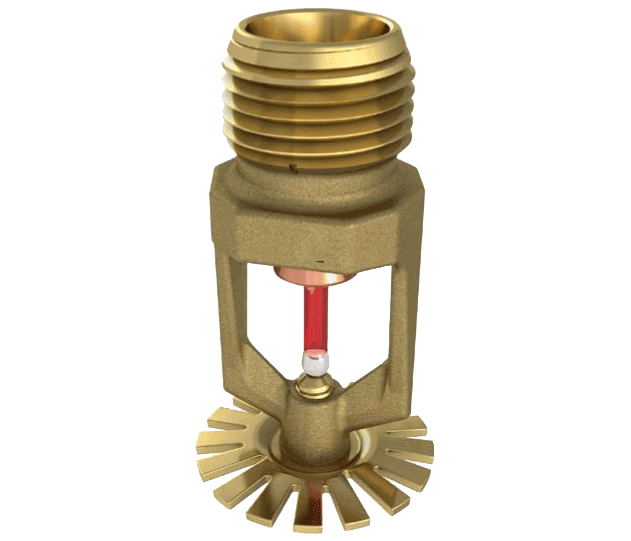
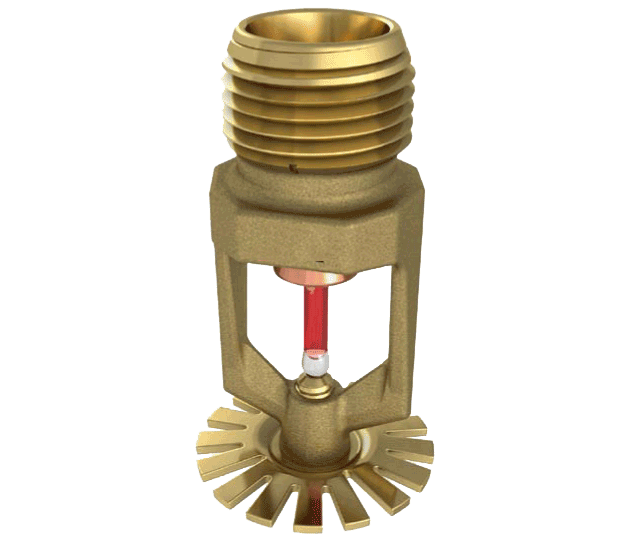
    Automatic sprinklers are thermosensitive devices designed to react at predetermined temperatures by automatically releasing a stream of water and distributing it in specified patterns and quantities over designated areas. The water is fed to the sprinklers through a system of piping, ordinarily overhead, with the sprinklers placed at intervals along the pipes. These sprinklers are subcategorized into different types based on different aspects:

    1. Operating Element:
    • Bulb Sprinklers

    This style of operating element uses a frangible bulb. The small bulb, usually of glass, contains a liquid that does not completely fill the bulb, leaving a small air bubble trapped in it. As heat expands the liquid, the bubble is compressed and finally absorbed by the liquid. Once the bubble disappears, the pressure rises substantially, and the bulb shatters, releasing the valve cap

    • Fusible Sprinklers

    A common fusible-style automatic sprinkler operates when a metal alloy of predetermined melting point fuses

    1. Temperature Rating:
    • Ordinary (57-77 ͦ C)
    • Intermediate (79-107 ͦ C)
    • High (121-149 ͦ C)
    • Extra High (163-191 ͦ C)
    • Very Extra High (204-246 C)
    • Ultra High (260-302 ͦ C)
    1. Response:
    • Standard Respons
    • Quick Response

    A type of spray sprinkler that has a thermal element with an RTI of 50 (meter-seconds)1/2 or less and is listed as a quick-response sprinkler for its intended use.

    1. Orientation:
    • Upright Sprinklers

    A sprinkler designed to be installed in such a way that the water spray is directed upwards against the deflector.

    • Pendent Sprinklers

    A sprinkler designed to be installed in such a way that the water stream is directed downward against the deflector.

    • Sidewall Sprinklers

    A sprinkler having special deflectors that are designed to discharge most of the water away from the nearby wall in a pattern resembling one-quarter of a sphere, with a small portion of the discharge directed at the wall behind the sprinkler.

    1. Decorative Features:
    • Recessed Sprinklers

    A sprinkler in which all or part of the body, other than the shank thread, is mounted within a recessed housing.

    • Flush Type Sprinklers

    A sprinkler in which all or part of the body, including the shank thread, is mounted above the lower plane of the ceiling.

    • Concealed Sprinklers

    A recessed sprinkler with cover plate.

    1. Special Type / Condition:
    • Dry Sprinklers

    A sprinkler secured in an extension nipple that has a seal at the inlet end to prevent water from entering the nipple until the sprinkler operates.

    • Open Sprinklers

    A sprinkler that does not have actuators or heat-responsive elements.

    • Residential Sprinklers

    A type of fast-response sprinkler having a thermal element with an RTI of 50 (meters seconds) 1/2 or less that has been specifically investigated for its ability to enhance survivability in the room of fire origin, and that is listed for use in the protection of dwelling units.

    • Large Drop Sprinklers

    Large drop sprinklers are special sprinklers with a nominal
    K-factor of 11.2 (Km = 160). (Nominal K-factors for standard ½ in. [12.7 mm] sprinklers are 5.6 [Km = 80].) The deflector of a large drop sprinkler is specially designed and, combined with the greater discharge, produces large drops of such size and velocity as to enable the spray to penetrate strong updraft generated by high-challenge fires.

    • Small and Large Orifices Sprinklers

    The terms small orifice and large orifice are used to describe sprinklers with orifice sizes other than ½ in. (K = 5.6).

    • Extended Coverage Sprinklers

    They have larger areas of coverage than the areas of coverage allowed for standard coverage sprinklers

    • Storage Sprinklers:
    • Control Mode Density Area Sprinklers (CMDA)

    A type of spray sprinkler intended to provide fire control in
    storage applications using the design density/area criteria
    described in NFPA 13.

    • Control Mode Specific Application Sprinklers (CMSA)

    A type of spray sprinkler that is capable of producing characteristic large water droplets and that is listed for its capability to provide fire control of specific high-challenge fire hazards

    • Early Suppression Fast Response Sprinklers (ESFR)

    A type of fast-response sprinkler that has a thermal element with an RTI of 50 (meters-seconds)1/2 or less and is listed for its capability to provide fire suppression of specific high-challenge fire hazards.

    • Intermediate Level Sprinklers

    A sprinkler equipped with integral shields to protect its operating elements from the discharge of sprinklers installed at higher elevations.

    It worth saying that all sprinklers except open sprinklers are not designed to extinguish fires. They either control fire or suppress fires. A fire control is defined as limiting the size of a fire by distribution of water so as to decrease the heat release rate and pre-wet adjacent combustibles, while controlling ceiling gas temperatures to avoid structural damage. On the contrary, fire suppression is defined as sharply reducing the heat release rate of a fire and preventing its regrowth by means of direct and sufficient application of water through the fire plume to the burning fuel surface. A sprinkler system is that consists of an integrated network of piping designed in accordance with fire protection engineering standards that includes a water supply source, a water control valve, a waterflow alarm, and a drain. The system is commonly activated by heat from a fire and discharges water over the fire area. NFPA 13, Standard for the Installation of Sprinkler Systems provides standardized rules for the design, installation, and acceptance testing of sprinkler systems. Different types of sprinklers systems are available. The main types are:

    1. Wet Type Sprinkler System

    A sprinkler system employing automatic sprinklers attached to a piping system containing water and connected to a water supply so that water discharges immediately from sprinklers opened by heat from a fire.

    1. Dry Type Sprinkler System

    A sprinkler system employing automatic sprinklers that are attached to a piping system containing air or nitrogen under pressure, the release of which (as from the opening of a sprinkler) permits the water pressure to open a valve known as a dry pipe valve, and the water then flows into the piping system and out the opened sprinklers.

    1. Pre-Action Sprinkler System

    A sprinkler system employing automatic sprinklers that are attached to a piping system that contains air that might or might not be under pressure, with a supplemental detection system installed in the same areas as the sprinklers.

    1. Deluge Sprinkler System

    A sprinkler system employing open sprinklers or nozzles that are attached to a piping system that is connected to a water supply through a valve that is opened by the operation of a detection system installed in the same areas as the sprinklers or the nozzles. when this valve opens, water flows into the piping system and discharges from all sprinklers or nozzles attached thereto.

    Other systems are addressed by various NFPA standards that utilize enhancements or modifications to sprinklers discharge characteristics to achieve different fire protection goals. These systems include spray systems and water mist systems.

    Learn More
  • SPRINKLERANLAGEN, STANDROHRE, FEUERWEHRHAUPTLEITUNG

    Sprinkleranlagen

    Automatische Sprinkler sind wärmeempfindliche Geräte, die bei einer vorbestimmten Temperatur auslösen und einen Wasserstrom freigeben. Dieser wird in festgelegten Mustern und Mengen über bestimmte Bereiche verteilt. Das Wasser wird den Sprinklern durch ein Rohrleitungssystem zugeführt. In der Regel passiert dieser Vorgang kopfüber, wobei die Sprinkler in regelmäßigen Abständen angeordnet sind. Die Sprinkler werden nach verschiedenen Aspekten in folgenden Kategorien unterteilt:
    1. Bedienelement
    • Deckensprinkleranlagen
    Hier wird ein Glaskolben verwendet, welcher mit einer Flüssigkeit und einer Luftblase gefüllt ist. Die Flüssigkeit dehnt sich bei Hitze aus, der Kolben bricht und die Anlage löst durch Freigeben der Ventilkappe aus.
    • Sprinkleranlage mit Schmelzlot
    Die herkömmliche Sprinkleranlage mit Schmelzfunktion löst aus wenn die Metalllegierung bei einem vorbestimmten Schmelzpunkt schmilzt.
    2. Temperaturbereich:
    • Normal (57-77 ͦ C)
    • Mittel (79 – 107 ° C)
    • Hoch (121-149 ͦ C)
    • Extrahoch (163-191 ͦ C)
    • Sehr hoch (204-246 C)
    • Ultrahoch (260-302 ͦ C)
    3. Reaktion:
    • Standard Reaktion
    • Schnelle Reaktion
    Der Schirmsprinkler reagiert besonders schnell, da er mit einem Thermoelement mit einem RTI-Wert von 50 (Meter/Sekunde)1/2 ausgestattet ist.
    4. Orientation:
    • Stehende Sprinkler
    Sprinkler die so installiert sind, dass der Wasserstrahl nach oben gegen den Deflektor gerichtet ist.
    • Hängende Sprinkler
    Sprinkler die so konstruiert sind, dass die Installation des Wasserstrahls nach unten in Richtung des Deflektors möglich ist.
    • Seitenwandsprinkler
    Sprinkler mit speziellen Deflektoren, welche so konzipiert sind, dass der größte Teil des Wassers von einer naheliegenden Wand in einem sichelförmigen Muster abgeleitet wird. Ein kleiner Teil des Wassers richtet sich beim Austritt an die Wand an welcher der Sprinkler angebracht ist.
    4. Optische Eigenschaften:
    • Abgesenkte Sprinkler
    Der Körper des Sprinklers oder ein Teil davon, abgesehen vom Schaftgewinde ist einem Gehäuse montiert.
    • Flush Sprinkler
    Der Körper des Sprinklers oder ein Teil davon, einschließlich des Schaftgewindes wird oberhalb der unteren Deckenebene montiert.
    • Versteckter Sprinkler
    Ein abgesenkter Sprinkler mit einer Abdeckplatte.
    6. Sonderausführungen / Voraussetzungen:
    • Trockensprinkleranlagen
    Der Sprinkler ist mit einem Verlängerungsnippel befestigt, an dessen Einlassende eine Dichtung sitzt, welche verhindert, dass das Wasser bereits vor seinem Einsatz in den Nippel eindringt.
    •  Offene Sprinkleranlagen
    Ein Sprinkler ohne Auslöser oder auf Wärme reagierende Elemente.
    • Wohn-Sprinkleranlagen
    Sprinkleranlagen mit schneller Auslösung, welche mit einem Thermoelement (RTI von <50 (Meter/Sekunde)1/2)ausgestattet sind, speziell um die Überlebensfähigkeit in vom Brand betroffenen Räumen zu erhöhen und somit den Schutz in Wohnanlagen zu gewähren.
    •  „Large Drop“-Sprinkleranlagen
    Spezielle Sprinkleranlagen mit einem Nennwert von
    K-Faktor von 11.2 (Km = 160). (Nominaler K-Faktor Standard bei Sprinkler: ½ Zoll [12.7 mm] 5.6 [Km = 80].) Durch die speziell konstruierten Deflektoren und der hohen Wasser-Austrittsmenge entstehen die großen Tröpfchen. Dadurch ist es möglich mit dem Löschmittel den starken Aufwind, welcher durch starke Brände erzeugt wird, zu durchdringen.
    • Sprinkleranlagen mit kleinen und größeren Düsen
    So werden Düsen mit abweichender Größe zu ½ Zoll (K = 5.6) bezeichnet.
    • Sprinkleranlagen mit Weitwinkel
    Größerer Deckungsbereich als Standard-Sprinkleranlagen.
    • Lagersprinkler:
    • Control Mode Density Area Sprinkler (CMDA)
    Ein Sprinkler, welcher vorwiegend zum Brandschutz in Lager-Bereichen eingesetzt wird. Designdichte/-fläche sind der NFPA 13 zu entnehmen.
    • Control Mode Specific Application Sprinkler (CMSA)
    Ein Sprinkler, welcher charakteristisch große Wassertropfen erzeugt und fähig ist Anforderungen hoher Brandgefahr zu erfüllen.
    • Early Suppression Fast Response Sprinkler (ESFR)
    Durch ein thermisches Element mit einem RTI-Wert von 50 (Meter/Sekunde) ½ Zoll oder weniger reagiert die Anlage besonders schnell und ist so für Objekte mit hoher Brandgefahr geeignet.
    • Intermediate Level Sprinkler
    Ein Sprinkler mit integrierter Abschirmung um die Bedienelemente vorm austretenden Löschmittel zu schützen.
    Bitte beachten Sie, dass Sprinkleranlagen nicht dafür gedacht sind Brände zu löschen. Ihre Hauptaufgabe beschränkt sich auf die Kontrolle und eindämmen des Brandes. Durch die Ausbringung des Löschmittels soll die Wärmefreisetzung verringert, benachbarte Brennstoffe benetzt und die Gastemperatur an der Deckel zum Vorbeugen struktureller Schäden kontrolliert werden.
    1. Nass-Sprinkleranlage
    Bei dieser Sprinkleranlage werden automatische Sprinkler verwendet, welche über ein wasserführendes Rohrleitungssystem an die Wasserversorgung angeschlossen sind. So tritt das Wasser direkt aus, wenn die Anlage durch einen Brand ausgelöst wird.
    2. Trocken-Sprinkleranlage
    Bei dieser Sprinkleranlage werden automatische Sprinkler verwendet, welche an ein Rohrsystem angeschlossen sind, das mit Druckluft oder Stickstoff gefüllt ist. Beim Auslösen der Anlage öffnet sich ein Trockenleitungsventil und das Wasser läuft erst dann durch das Rohrleitungssystem zu den Sprinklerköpfen und tritt aus.
    3. Vorgesteuerte Sprinkleranlage (Pre-Action-System)
    Die Sprinkleranlage ist ebenso mit automatischen Sprinklern ausgestattet, welche an einem mit Druckluft gefülltem Rohrsystem angeschlossen sind. Zusätzlich ist die Anlage mit einem Brandmelder ausgestattet.
     4. Sprühwasser-Löschanlagen
    Eine Löschanlage mit eingebauten Sprinklern oder Düsen, welche an ein Rohrleitungssystem angeschlossen sind, das an über ein Ventil mit der Wasserversorgung verbunden ist. Durch eine Meldeanlage, installiert in denselben Bereichen wie die Löschanlage, wird das Ventil geöffnet und das Wasser strömt in das Rohrleitungssystem und verteilt sich auf die Sprinkler oder Düsen.
    Weitere Systeme richten sich nach unterschiedlichen NFPA-Standards, welche Verbesserungen oder Modifikationen der Sprinkler-Auslöse-Eigenschaften beinhalten um verschiedene Brandschutzziele zu erreichen.  Diese Anlagen umfassen Sprühsysteme und Wassernebelsysteme.

    Learn More