


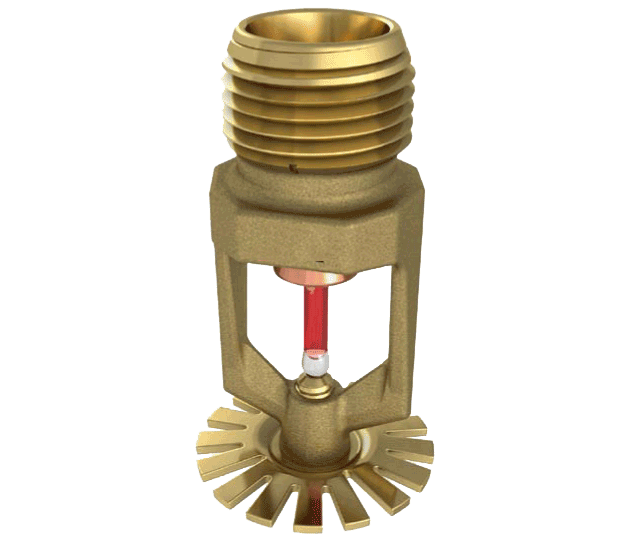
Automatic sprinklers are thermosensitive devices designed to react at predetermined temperatures by automatically releasing a stream of water and distributing it in specified patterns and quantities over designated areas. The water is fed to the sprinklers through a system of piping, ordinarily overhead, with the sprinklers placed at intervals along the pipes. These sprinklers are subcategorized into different types based on different aspects:
This style of operating element uses a frangible bulb. The small bulb, usually of glass, contains a liquid that does not completely fill the bulb, leaving a small air bubble trapped in it. As heat expands the liquid, the bubble is compressed and finally absorbed by the liquid. Once the bubble disappears, the pressure rises substantially, and the bulb shatters, releasing the valve cap
A common fusible-style automatic sprinkler operates when a metal alloy of predetermined melting point fuses
A type of spray sprinkler that has a thermal element with an RTI of 50 (meter-seconds)1/2 or less and is listed as a quick-response sprinkler for its intended use.
A sprinkler designed to be installed in such a way that the water spray is directed upwards against the deflector.
A sprinkler designed to be installed in such a way that the water stream is directed downward against the deflector.
A sprinkler having special deflectors that are designed to discharge most of the water away from the nearby wall in a pattern resembling one-quarter of a sphere, with a small portion of the discharge directed at the wall behind the sprinkler.
A sprinkler in which all or part of the body, other than the shank thread, is mounted within a recessed housing.
A sprinkler in which all or part of the body, including the shank thread, is mounted above the lower plane of the ceiling.
A recessed sprinkler with cover plate.
A sprinkler secured in an extension nipple that has a seal at the inlet end to prevent water from entering the nipple until the sprinkler operates.
A sprinkler that does not have actuators or heat-responsive elements.
A type of fast-response sprinkler having a thermal element with an RTI of 50 (meters seconds) 1/2 or less that has been specifically investigated for its ability to enhance survivability in the room of fire origin, and that is listed for use in the protection of dwelling units.
Large drop sprinklers are special sprinklers with a nominal
K-factor of 11.2 (Km = 160). (Nominal K-factors for standard ½ in. [12.7 mm] sprinklers are 5.6 [Km = 80].) The deflector of a large drop sprinkler is specially designed and, combined with the greater discharge, produces large drops of such size and velocity as to enable the spray to penetrate strong updraft generated by high-challenge fires.
The terms small orifice and large orifice are used to describe sprinklers with orifice sizes other than ½ in. (K = 5.6).
They have larger areas of coverage than the areas of coverage allowed for standard coverage sprinklers
A type of spray sprinkler intended to provide fire control in
storage applications using the design density/area criteria
described in NFPA 13.
A type of spray sprinkler that is capable of producing characteristic large water droplets and that is listed for its capability to provide fire control of specific high-challenge fire hazards
A type of fast-response sprinkler that has a thermal element with an RTI of 50 (meters-seconds)1/2 or less and is listed for its capability to provide fire suppression of specific high-challenge fire hazards.
A sprinkler equipped with integral shields to protect its operating elements from the discharge of sprinklers installed at higher elevations.
It worth saying that all sprinklers except open sprinklers are not designed to extinguish fires. They either control fire or suppress fires. A fire control is defined as limiting the size of a fire by distribution of water so as to decrease the heat release rate and pre-wet adjacent combustibles, while controlling ceiling gas temperatures to avoid structural damage. On the contrary, fire suppression is defined as sharply reducing the heat release rate of a fire and preventing its regrowth by means of direct and sufficient application of water through the fire plume to the burning fuel surface. A sprinkler system is that consists of an integrated network of piping designed in accordance with fire protection engineering standards that includes a water supply source, a water control valve, a waterflow alarm, and a drain. The system is commonly activated by heat from a fire and discharges water over the fire area. NFPA 13, Standard for the Installation of Sprinkler Systems provides standardized rules for the design, installation, and acceptance testing of sprinkler systems. Different types of sprinklers systems are available. The main types are:
A sprinkler system employing automatic sprinklers attached to a piping system containing water and connected to a water supply so that water discharges immediately from sprinklers opened by heat from a fire.
A sprinkler system employing automatic sprinklers that are attached to a piping system containing air or nitrogen under pressure, the release of which (as from the opening of a sprinkler) permits the water pressure to open a valve known as a dry pipe valve, and the water then flows into the piping system and out the opened sprinklers.
A sprinkler system employing automatic sprinklers that are attached to a piping system that contains air that might or might not be under pressure, with a supplemental detection system installed in the same areas as the sprinklers.
A sprinkler system employing open sprinklers or nozzles that are attached to a piping system that is connected to a water supply through a valve that is opened by the operation of a detection system installed in the same areas as the sprinklers or the nozzles. when this valve opens, water flows into the piping system and discharges from all sprinklers or nozzles attached thereto.
Other systems are addressed by various NFPA standards that utilize enhancements or modifications to sprinklers discharge characteristics to achieve different fire protection goals. These systems include spray systems and water mist systems.
لم يتم العثور على أي صور.

أنظمة الرشاشات:
تعرف الرشاشات التلقائية على أنها أجهزة حساسة للحرارة مصممة للاستجابة عند درجات حرارة محددة وذلك بتفريغ دفق المياه آليا وتوزيعه بأشكال وكميات محددة على مناطق معينة ، حيث يتم تغذية الرشاشات بالماء من خلال شبكة من المواسيرالمعلقة في الأسقف ، وتوزع الرشاشات على طول المواسيربحيث تفصل بينها مسافات محددة ، ويتم تقسيمها إلى أنواع مختلفة بناء على عدة جوانب:
1.عنصر التشغيل
2. نطاق درجات حرارة التشغيل
3. أنواع الاستجابة
4. اتجاه تفريغ الرشاشات
5.الرشاشات الديكورية
6. رشاشات ذات أنوع وتطبيقات خاصة
ومن الجدير بالذكر أن جميع الرشاشات فيما عدى الرشاشات المفتوحة غير مصممة لإطفاء الحرائق ، فهي إما توفر تحكما أو إخمادا للحريق ، ويعرف التحكم في الحريق على أنه الحد من قدرة الحريق على الانتشار ، وذلك بتوزيع المياه بهدف تقليل معدلات انتقال الحرارة وتعريض المناطق المحيطة بالحريق للبلل مع التحكم في درجة حرارة الغازات الملامسة للأسقف لتجنب انهيار المنشآت ، فيما يعرف إخماد الحريق على أنه الخفض الحاد لمعدلات انتقال الحرارة من الحريق ومنع انتشارالحريق وارتفاع ألسنة اللهب من جديد ، وذلك عن طريق التفريغ المباشر لكمية كافية من المياه على ألسنة اللهب وصولا إلى الأسطح المحترقة ، وتعرف أنظمة الرشاشات على أنها تلك الأنظمة التي تتكون من شبكة متكاملة من المواسير والمصممة طبقا للمواصفات القياسية لأنظمة الوقاية من الحريق التي تحتوى على مصدر للمياه ، ومحبس للتحكم في المياه ، وجهاز للإنذار عند بدء سريان المياه ، ومصرف للمياه ، ويتم تشغيل تلك الأنظمة بواسطة الحرارة الناتجة عن الحريق ليقوم برش المياه على المناطق التي اشتعل فيها الحريق ، وتوفر المواصفة القياسية رقم (NFPA 13) المتطلبات اللازمة لتصميم وتركيب واختبار تلك الأنظمة ، وتحتوى تلك المواصفة على عدة أنواع من أنظمة الرشاشات وهي كالتالي:
1. نظام الرشاشات الرطبة (Wet Type)
هو نظام للرشاشات يتضمن رشاشات تلقائية متصلة بشبكة مواسير تحتوي على المياه ومتصلة بمصدر للمياه بحيث يتم تفريغ المياه مباشرة من الرشاشات التي تم تشغيلها بواسطة الحرارة الناتجة من الحريق.
2. نظام الرشاشات الجافة (Dry Type)
هو نظام للرشاشات يتضمن رشاشات تلقائية متصلة بشبكة مواسير تحتوي على الهواء أو النيتروجين المضغوط ، بحيث يؤدي تشغيل رشاش إلى السماح لضغط المياه بفتح محبس يعرف بالمحبس الجاف ، مما يسمح للمياه بالتدفق من خلال شبكة المواسير إلى الرشاشات التي تم تشغيلها.
3. نظام الرشاشات مؤخرة التفعيل (Pre-Action)
هو نظام للرشاشات يتضمن رشاشات تلقائية متصلة بشبكة مواسير تحتوي على هواء قد يكون مضغوط أو غير مضغوط ، مع تركيب نظام إنذار حريق إضافي في نفس المناطق التي تم تركيب الرشاشات التلقائية فيها.
4. نظام رشاشات الغمر الكلي (Deluge Sprinkler)
هو نظام للرشاشات يتضمن رشاشات مفتوحة أو فوهات متصلة بشبكة مواسير متصلة بمصدر المياه عن طريق محبس يتم فتحه بواسطة نظام الإنذار من الحريق الذي يتم تركيبه في نفس مناطق تركيب تلك الرشاشات أو الفوهات ، بحيث تدفق المياه إلى شبكة المواسير عند فتح المحبس ومنها إلى الرشاشات أو الفوهات التي اقوم بتفريغ المياه.
وتتضمن المواصفات القياسية الأخرى التي تصدرها المؤسسة الأمريكية للوقاية من الحريق عددا من الأنظمة التي تتضمن إدخال تحديثات على طريقة تفريغ الرشاشات لتحقيق أهداف معينة في مجال الحماية من خطر الحريق ، ومن ذلك أنظمة الإطفاء بالرذاذ الموجه ، وأنظمة الإطفاء بالضباب المائي.
لم يتم العثور على أي صور.