


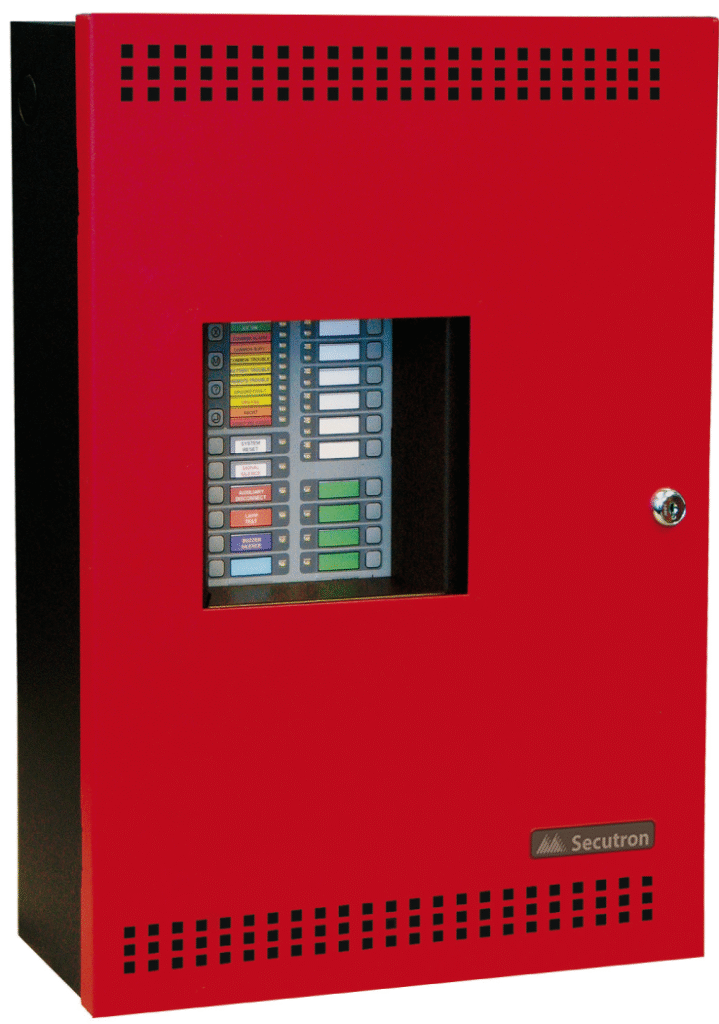
• Listed to UL 864, 9th edition
• Field configurable to operate with a Deluge Sprinkler System, a Pre-action Sprinkler System and an Agent Release System
• Six Class B (Style B) Input Circuits
• Input Circuits One to Four can be configured as Non-Verified Alarm, Non Latching Supervisory, Latching Supervisory or Agent Release/Water Flow
depending on the Mode of Operation selected
• Input Circuits Five & Six can be configured as Manual Release Input, Abort Input or Abort/Manual
Release Combination Input depending on the Mode of Operation selected
• Input Circuits can be converted to Class “A” (Style “D”) using the MR-2300-A Converter Module
• Four Class “B” (Style “Y”) Output Circuits which can be configured for Silenceable Signal, Non-Silenceable Signal, Silenceable Strobe, Non-Silenceable Strobe or Releasing Circuit (Circuits 3 & 4 Only)
• Output Circuits can be converted to Class “A” (Style “Z”) using the MR-2300-NC4 Converter Module
• 6 Amp Power Supply
• 4-wire smoke power 22.3 VDC @ 300ma max. Supervised Aux Power 22.3 VDC @ 500ma max.
• Aux Power (Unregulated) 24 VDC @ 1.7 Amp max.
• Relay contacts for Common Alarm (Non Disconnectable), Auxiliary Alarm (Disconnectable),
Common Supervisory (can be converted to common alarm if no Supervisory input) and Common Trouble
• Cross Zone option
• Counting Zones option
• Output signals can be configured for Steady (fixed) or Escalating (tone changes as input operation changes)
• Release Timer 0 to 60 Seconds (5 second increments)
• Manual Release Delay 0 to 30 Seconds (5 second increments)
• Soak Timer 0 to 15 Minutes (21 Intervals)
• Abort Release Timer (Standard UL Type Delay, IRL
Type Delay, NYC Type Delay, Local Jurisdiction Delay)
• Special Releasing Power Supply and Release Activation Considerations preventing false dumps
• Configurable to perform two hazard areas
• Simple panel programming through 14 Pre- Configured Modes of Operations
No images found.