

No files found.
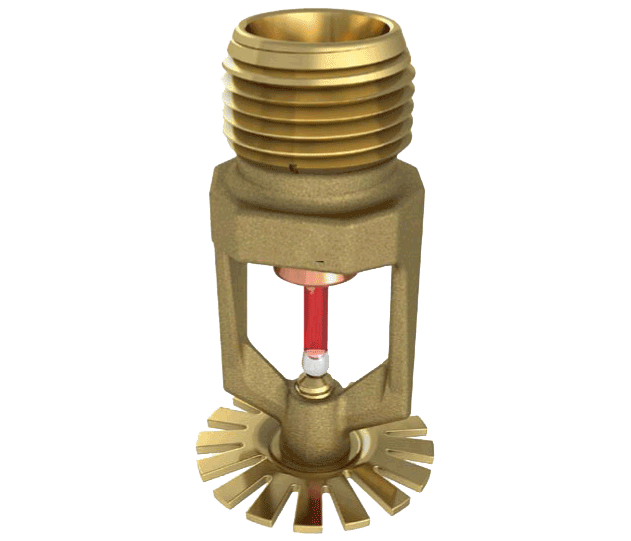
Automatic sprinklers are thermosensitive devices designed to react at predetermined temperatures by automatically releasing a stream of water and distributing it in specified patterns and quantities over designated areas. The water is fed to the sprinklers through a system of piping, ordinarily overhead, with the sprinklers placed at intervals along the pipes. These sprinklers are subcategorized into different types based on different aspects:
This style of operating element uses a frangible bulb. The small bulb, usually of glass, contains a liquid that does not completely fill the bulb, leaving a small air bubble trapped in it. As heat expands the liquid, the bubble is compressed and finally absorbed by the liquid. Once the bubble disappears, the pressure rises substantially, and the bulb shatters, releasing the valve cap
A common fusible-style automatic sprinkler operates when a metal alloy of predetermined melting point fuses
A type of spray sprinkler that has a thermal element with an RTI of 50 (meter-seconds)1/2 or less and is listed as a quick-response sprinkler for its intended use.
A sprinkler designed to be installed in such a way that the water spray is directed upwards against the deflector.
A sprinkler designed to be installed in such a way that the water stream is directed downward against the deflector.
A sprinkler having special deflectors that are designed to discharge most of the water away from the nearby wall in a pattern resembling one-quarter of a sphere, with a small portion of the discharge directed at the wall behind the sprinkler.
A sprinkler in which all or part of the body, other than the shank thread, is mounted within a recessed housing.
A sprinkler in which all or part of the body, including the shank thread, is mounted above the lower plane of the ceiling.
A recessed sprinkler with cover plate.
A sprinkler secured in an extension nipple that has a seal at the inlet end to prevent water from entering the nipple until the sprinkler operates.
A sprinkler that does not have actuators or heat-responsive elements.
A type of fast-response sprinkler having a thermal element with an RTI of 50 (meters seconds) 1/2 or less that has been specifically investigated for its ability to enhance survivability in the room of fire origin, and that is listed for use in the protection of dwelling units.
Large drop sprinklers are special sprinklers with a nominal
K-factor of 11.2 (Km = 160). (Nominal K-factors for standard ½ in. [12.7 mm] sprinklers are 5.6 [Km = 80].) The deflector of a large drop sprinkler is specially designed and, combined with the greater discharge, produces large drops of such size and velocity as to enable the spray to penetrate strong updraft generated by high-challenge fires.
The terms small orifice and large orifice are used to describe sprinklers with orifice sizes other than ½ in. (K = 5.6).
They have larger areas of coverage than the areas of coverage allowed for standard coverage sprinklers
A type of spray sprinkler intended to provide fire control in
storage applications using the design density/area criteria
described in NFPA 13.
A type of spray sprinkler that is capable of producing characteristic large water droplets and that is listed for its capability to provide fire control of specific high-challenge fire hazards
A type of fast-response sprinkler that has a thermal element with an RTI of 50 (meters-seconds)1/2 or less and is listed for its capability to provide fire suppression of specific high-challenge fire hazards.
A sprinkler equipped with integral shields to protect its operating elements from the discharge of sprinklers installed at higher elevations.
It worth saying that all sprinklers except open sprinklers are not designed to extinguish fires. They either control fire or suppress fires. A fire control is defined as limiting the size of a fire by distribution of water so as to decrease the heat release rate and pre-wet adjacent combustibles, while controlling ceiling gas temperatures to avoid structural damage. On the contrary, fire suppression is defined as sharply reducing the heat release rate of a fire and preventing its regrowth by means of direct and sufficient application of water through the fire plume to the burning fuel surface. A sprinkler system is that consists of an integrated network of piping designed in accordance with fire protection engineering standards that includes a water supply source, a water control valve, a waterflow alarm, and a drain. The system is commonly activated by heat from a fire and discharges water over the fire area. NFPA 13, Standard for the Installation of Sprinkler Systems provides standardized rules for the design, installation, and acceptance testing of sprinkler systems. Different types of sprinklers systems are available. The main types are:
A sprinkler system employing automatic sprinklers attached to a piping system containing water and connected to a water supply so that water discharges immediately from sprinklers opened by heat from a fire.
A sprinkler system employing automatic sprinklers that are attached to a piping system containing air or nitrogen under pressure, the release of which (as from the opening of a sprinkler) permits the water pressure to open a valve known as a dry pipe valve, and the water then flows into the piping system and out the opened sprinklers.
A sprinkler system employing automatic sprinklers that are attached to a piping system that contains air that might or might not be under pressure, with a supplemental detection system installed in the same areas as the sprinklers.
A sprinkler system employing open sprinklers or nozzles that are attached to a piping system that is connected to a water supply through a valve that is opened by the operation of a detection system installed in the same areas as the sprinklers or the nozzles. when this valve opens, water flows into the piping system and discharges from all sprinklers or nozzles attached thereto.
Other systems are addressed by various NFPA standards that utilize enhancements or modifications to sprinklers discharge characteristics to achieve different fire protection goals. These systems include spray systems and water mist systems.
Standpipe systems are fixed piping systems with associated equipment that transports water from a reliable water supply to designated areas of buildings where hoses can be deployed for fire fighting. These systems are commonly used in tall and large-area buildings. They can significantly improve the efficiency of manual fire-fighting operations by eliminating the need for long and heavy hoses from fire apparatus to a fire. They can also serve as a backup for, and complement to, sprinklers. NFPA 14, Standard for the Installation of Standpipe and Hose Systems regulates the design, installation and testing of standpipes systems. Other NFPA standards are responsible for specifying where standpipe systems are required. Standpipe systems are used in full-scale fire fighting, first-aid fire fighting, or both. These uses correspond to three standpipe systems classes which are:
A Class I system provides 2½ in. (65 mm) hose connections at designated locations in a building for use by the fire department.
A Class II system provides 1 in. (25 mm) or 1½ in. (40 mm) hose connections at designated locations in a building for first aid fire fighting. These systems are generally intended for use by trained fire brigades before the fire department arrives.
Class III systems combine the features of Class I and Class II systems. They are provided for both full scale and first-aid fire fighting.
It worth saying that sprinkler systems with hose connections are
not necessarily considered to be standpipe systems. Standpipe system are also sub-divided into types that determine the basic characteristics of system. These types are:
These systems have piping that is filled with water at all times and have an automatically available water supply capable of supplying the water demand necessary for fire-fighting.
These systems have piping that is normally filled with pressurized air. They are arranged, through the use of devices such as a dry-pipe valve, to automatically admit water into system piping when a hose valve is opened, and they are connected to an automatically available water supply that is capable of supplying the water demand necessary for fire-fighting
These systems have piping that is normally filled with air that may or may not be pressurized. They are arranged through the use of devices, such as a deluge valve, to admit water into system piping when a remote actuation device located at a hose station, such as a pull station, is operated. They also have a preconnected water supply that is capable of supplying the water demand necessary for fire-fighting.
These systems have piping that is normally filled with air, and these systems do not have a preconnected water supply. A fire department connection must be used to manually supply water for fire-fighting.
These systems have piping that is normally filled with water for the purpose of keeping the system full of water, thus avoiding “fill time” when the system is used. The water supply for these systems is typically provided by a small connection to domestic water piping, and it is not capable of supplying fire-fighting water demands. A fire department connection must be used to manually supply water for fire-fighting.
Defining this purpose is a key factor in specifying the hydrant outlet pressure and flow performance criteria. Two types of fire hydrants are available:
A type of hydrant with the main control valve below the frost line between the foot piece and the barrel.
A type of hydrant that is intended for use where there is no danger of freezing weather and where each outlet is provided with a valve and an outlet.
All previously discussed systems and components are provided by Bavaria to satisfy the customers’ needs. Please check our products technical datasheets for more information or contact us.
No images found.